Data Science vs Data Analytics: What’s the Difference?
Introduction
Data is everywhere.
Every time you use Google, YouTube, Amazon, Netflix, Instagram, or a banking application, you generate data.
But collecting data is only the beginning.
The real value comes from answering questions like:
- What happened?
- Why did it happen?
- What is likely to happen next?
- What action should a company take?
This is where Data Analytics and Data Science come in.
Although these terms are often used interchangeably, they are different career paths with significant overlap.
Let's understand the difference in simple terms.
📊 What is Data Analytics?
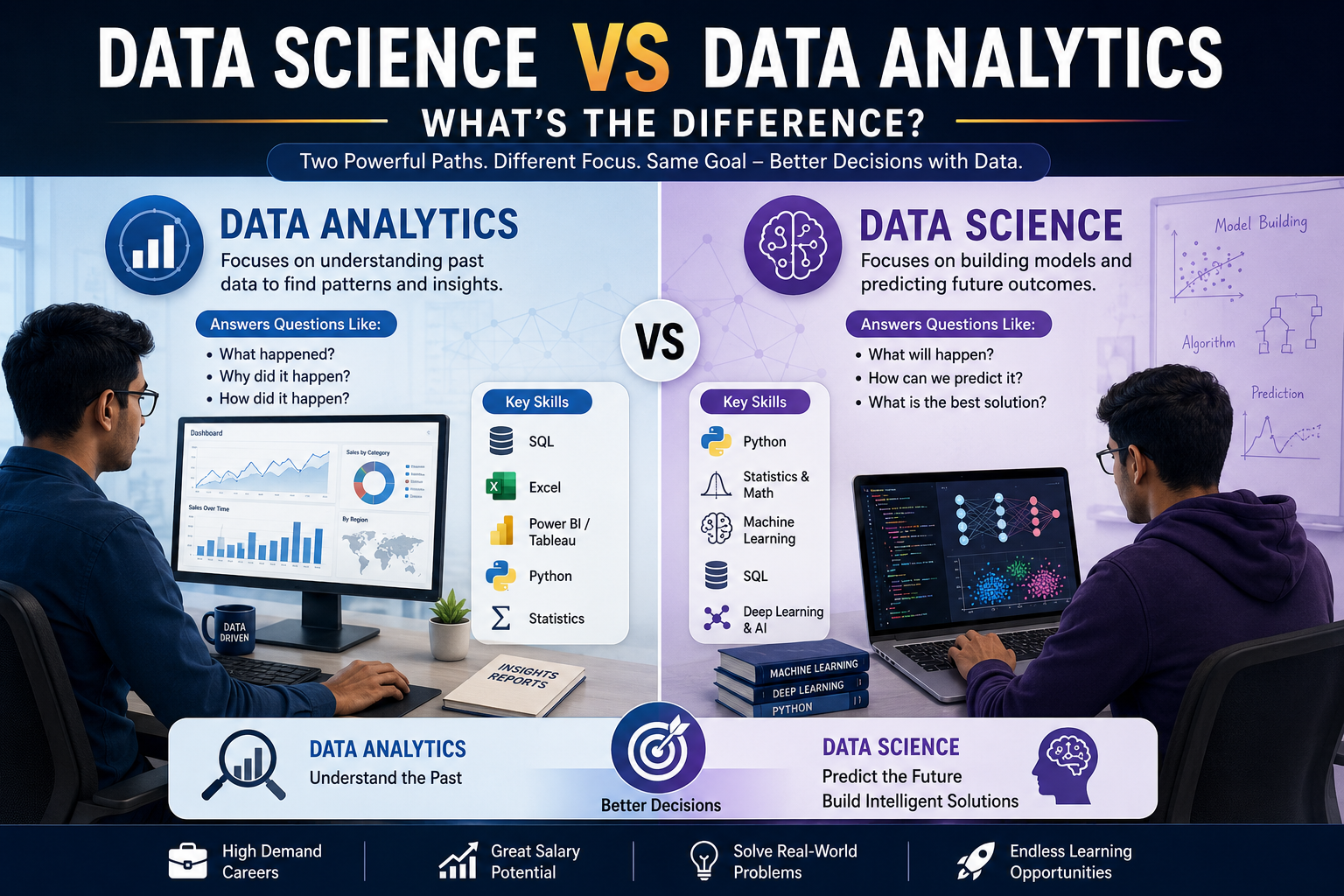
Data Analytics is the process of collecting, cleaning, analyzing, and interpreting existing data to identify trends and generate useful business insights.
A Data Analyst primarily focuses on understanding what happened and why it happened.
Example
Imagine an e-commerce company notices that its sales have dropped by 20%.
A Data Analyst might investigate:
- Which products experienced a decline?
- Which location had the biggest drop?
- Which month did the decline begin?
- Which marketing campaign performed poorly?
- Which customer segment stopped purchasing?
The analyst then presents the findings through reports, dashboards, and visualizations.
In simple words:
Data Analytics = Understand the past and present using data.
🤖 What is Data Science?
Data Science is a broader field that combines programming, statistics, mathematics, machine learning, and AI to extract insights from data and build predictive solutions.
A Data Scientist may ask:
- What is likely to happen next?
- Which customers are likely to leave?
- How much product demand should we expect?
- Can we automatically detect fraud?
- Which product should we recommend to a customer?
Example
Using the same e-commerce company, a Data Scientist could build a machine learning model that predicts which customers are likely to stop purchasing.
The company can then proactively offer those customers discounts or personalized recommendations.
In simple words:
Data Science = Use data to understand, predict, and build intelligent solutions.
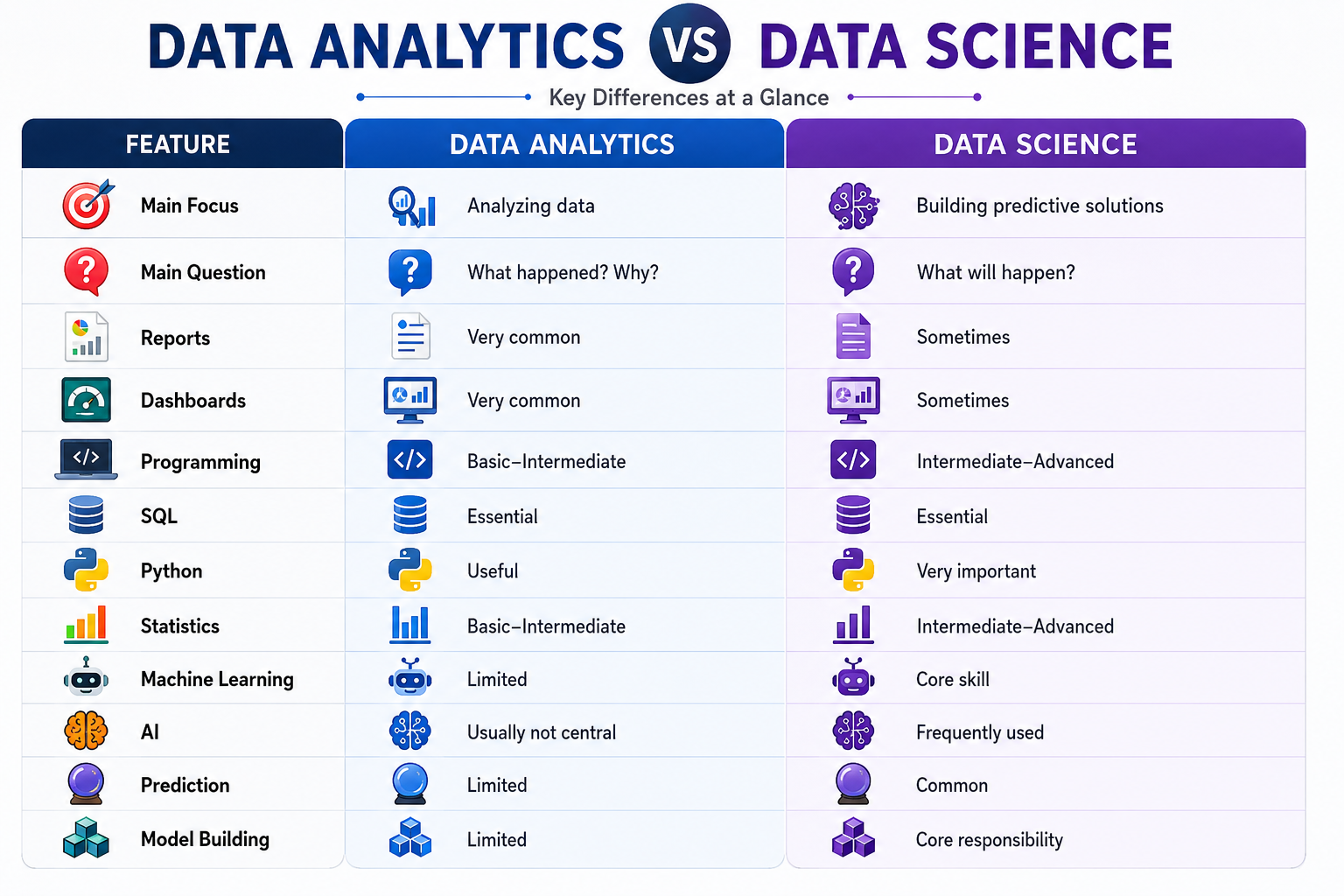
⚔️ Data Science vs Data Analytics
Note: The exact responsibilities can vary from company to company. Some Data Analysts use machine learning, while some Data Scientists spend significant time doing traditional data analysis.
🎯 A Simple Real-World Example
Let's take Netflix.
Imagine Netflix has millions of users.
👨💻 Data Analyst
A Data Analyst might answer:
"Which movies were watched the most last month?"
They analyze historical viewing data and create a dashboard.
🤖 Data Scientist
A Data Scientist might answer:
"Which movie is this user most likely to watch next?"
They can use user behavior and machine learning models to generate predictions.
The difference:
Data Analyst
Data → Analysis → Insights
Data Scientist
Data → Analysis → Machine Learning → Prediction
🛠️ Skills Required for Data Analytics
If you want to become a Data Analyst, start with these skills:
1. SQL
Learn:
- SELECT
- WHERE
- GROUP BY
- ORDER BY
- JOIN
- Subqueries
- CTEs
- Window Functions
2. Excel
Important concepts include:
- XLOOKUP
- VLOOKUP
- Pivot Tables
- Charts
- Formulas
- Data Cleaning
3. Python
Focus on:
- Python fundamentals
- Pandas
- NumPy
- Matplotlib
- Data cleaning
4. Data Visualization
Popular tools include:
- Power BI
- Tableau
- Excel
- Matplotlib
- Seaborn
5. Statistics
Learn:
- Mean
- Median
- Mode
- Variance
- Standard Deviation
- Probability
- Correlation
- Basic hypothesis testing
Skills Required for Data Science
Data Science generally requires a broader technical skill set.
1. Python
Learn Python for:
- Data processing
- Analysis
- Machine Learning
- Automation
- AI
2. Mathematics & Statistics
Important topics include:
- Probability
- Statistics
- Linear Algebra
- Calculus basics
- Hypothesis Testing
- Regression
3. Machine Learning
Learn:
- Linear Regression
- Logistic Regression
- Decision Trees
- Random Forest
- Classification
- Clustering
- Feature Engineering
- Model Evaluation
4. Data Engineering Fundamentals
You should understand:
- SQL
- Databases
- Data preprocessing
- ETL concepts
- Working with large datasets
5. Advanced AI
Depending on your career path, you can later learn:
- Deep Learning
- NLP
- Computer Vision
- Generative AI
- Recommendation Systems
- Large Language Models
💼 Data Analyst vs Data Scientist: Career Path
Data Analytics Path
Excel
   ↓
SQL
   ↓
Statistics
   ↓
Power BI / Tableau
   ↓
Python
   ↓
Data Analyst
Data Science Path
Python
   ↓
SQL
   ↓
Statistics & Mathematics
   ↓
Data Analysis
   ↓
Machine Learning
   ↓
Deep Learning
   ↓
Data Scientist
Which One Should You Choose?
Choose Data Analytics if you enjoy:
- SQL and databases
- Creating dashboards
- Finding patterns in data
- Business problems
- Reporting and visualization
- Explaining insights to stakeholders
Choose Data Science if you enjoy:
✅ Programming
✅ Mathematics and statistics
✅ Machine Learning
✅ AI
✅ Predictive modeling
✅ Building intelligent systems
🚀 What Should Beginners Learn First?
If you are completely new to the data field, don't try to learn everything at once.
A practical roadmap is:
1️⃣ Excel
      ↓
2️⃣ SQL
      ↓
3️⃣ Statistics
      ↓
4️⃣ Python
      ↓
5️⃣ Pandas & NumPy
      ↓
6️⃣ Power BI / Tableau
      ↓
7️⃣ Machine Learning
      ↓
8️⃣ AI / Generative AI
You can then specialize based on your interests.
🔥 Data Analytics → Data Science → AI
One important thing to understand is that these fields are connected.
You can think of them like this:
                 DATA
                   │
          ┌────────┴────────┐
          ↓                 ↓
    DATA ANALYTICS     DATA SCIENCE
          │                 │
          ↓                 ↓
     Insights          Machine Learning
                            │
                            ↓
                           AI
Your career doesn't have to stay in one category forever.
A person can start with Data Analytics, move into Data Science, and eventually specialize in Machine Learning or AI.
💡 Final Takeaway
The easiest way to remember the difference is:
📊 Data Analytics
"What happened and why?"
🤖 Data Science
"What will happen and what can we build using data?"
Both are valuable career paths.
If you're a beginner, start with SQL, Excel, Python, statistics, and data visualization.
Once you have a strong foundation, you can move toward Machine Learning, Data Science, Generative AI, or AI Engineering.
🎯 Final Recommendation
Don't choose a career simply because a particular field is trending.
Choose based on the type of problems you enjoy solving.
If you enjoy understanding data → Start with Data Analytics.
If you enjoy programming + mathematics + prediction → Explore Data Science.
If you enjoy building intelligent applications → Move toward AI/ML Engineering.
The most important thing is not the title.
It's the skills you build and the problems you learn to solve.