Will AI Replace Jobs? The Truth About the Future of Work
Will AI Replace Jobs? The Truth About the Future of Work
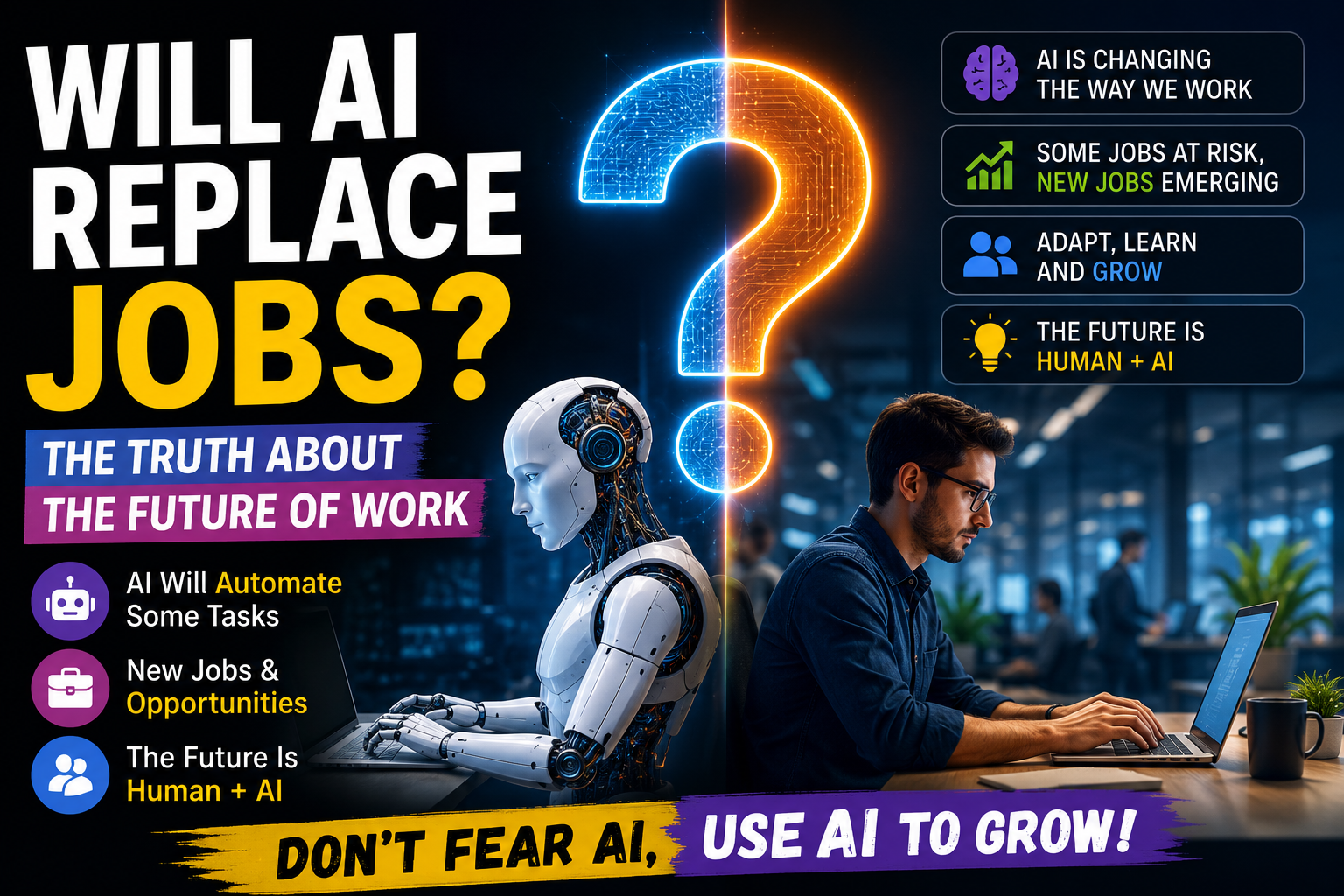
Artificial Intelligence is changing the way we work faster than ever before.
From writing code and creating content to analyzing data and automating business processes, AI can now perform many tasks that previously required human effort.
This raises an important question:
Will AI replace jobs completely, or will it transform the way we work?
AI Will Replace Some Tasks, Not Every Job
The biggest misconception is that AI will simply replace every human worker.
In reality, AI is more likely to automate specific tasks within a job.
For example, a software developer can use AI to:
- Generate boilerplate code
- Find bugs
- Write unit tests
- Explain unfamiliar code
- Create documentation
- Convert code from JavaScript to TypeScript
- Generate development ideas
But building a complete production system still requires understanding requirements, architecture, security, business logic, trade-offs, and communication.
So instead of:
AI vs Developer
The future is more likely to be:
Developer + AI vs Developer without AI
Which Jobs Are More at Risk?
Jobs with repetitive, predictable, and rule-based tasks are more likely to experience significant automation.
Examples include:
- Data entry
- Basic customer support
- Simple content generation
- Repetitive administrative work
- Basic data processing
- Routine documentation
- Certain repetitive coding tasks
This doesn't necessarily mean these professions will disappear completely.
Instead, the number of people required to perform the same amount of work may decrease, while the responsibilities of remaining workers may change.
AI Will Also Create New Jobs
Every major technological revolution has eliminated some types of work while creating new opportunities.
AI is already creating demand for roles such as:
- AI Engineer
- Machine Learning Engineer
- AI Product Manager
- AI Automation Engineer
- AI Agent Developer
- MLOps Engineer
- AI Security Specialist
- Data Engineer
- AI Consultant
We are also seeing new opportunities around Generative AI, RAG, AI Agents, automation, and Model Context Protocol (MCP).
The Most Valuable Skill Will Be Adaptability
Learning one technology and relying on it for your entire career is becoming increasingly risky.
For example, a developer who only knows how to write basic CRUD applications may face more competition as AI becomes better at generating standard application code.
But a developer who understands:
- System design
- Architecture
- Problem solving
- Business requirements
- AI tools
- APIs
- Cloud
- Security
- Testing
- Communication
can use AI as a productivity multiplier.
The future belongs to people who can work effectively with AI, not necessarily those who compete against it.
What Should Developers Learn?
If you're a software developer, don't just learn how to use an AI chatbot.
Learn how AI-powered applications actually work.
A strong learning path can include:
- Generative AI fundamentals
- Large Language Models (LLMs)
- Prompt engineering
- Embeddings
- RAG
- Vector databases
- Tool calling
- AI Agents
- Agent frameworks
- MCP
- AI application development
- AI-powered automation
At the same time, continue strengthening your core engineering skills.
JavaScript, React, TypeScript, backend development, databases, APIs, cloud, testing, and system design are still valuable.
AI works best when combined with strong engineering fundamentals.
AI Won't Replace Everyone — But People Using AI May Replace People Who Don't
This is one of the most important lessons.
Imagine two developers with similar experience.
Developer A
Writes everything manually and avoids AI tools.
Developer B
Uses AI to generate boilerplate, analyze errors, write tests, explore solutions, and automate repetitive tasks — while still reviewing and understanding the output.
Developer B can potentially complete certain tasks faster and spend more time focusing on architecture, problem solving, and complex engineering challenges.
Therefore, the real competition may not be:
Humans vs AI
It may be:
Humans using AI vs humans not using AI.
The Future Is Human + AI
AI is extremely powerful, but it still has limitations.
Humans provide:
- Creativity
- Context
- Judgment
- Empathy
- Leadership
- Accountability
- Domain expertise
- Decision-making
AI provides:
- Speed
- Automation
- Pattern recognition
- Code generation
- Information processing
- Assistance
The combination can be much more powerful than either one alone.
Conclusion
Will AI replace jobs?
Yes, some jobs and many individual tasks will be automated.
But AI is unlikely to simply eliminate all human employment.
The bigger change will be the transformation of jobs.
Developers, designers, marketers, analysts, and other professionals who learn to use AI effectively can gain a significant advantage.
So instead of asking:
"Will AI take my job?"
Start asking:
"How can I use AI to become better at my job?"
Because the future may not belong to people who avoid AI.
It may belong to people who learn how to work with it.